Gregory Coutaut in conversation with Nelson Makengo
The origin of Tongo Saa (Rising up at night) traces back to your short film Nuit debout (Up at night) from 2019, where you already captured the consequences of power outages in Kinshasa. What inspired you to revisit this subject in the form of a feature film?
The starting point actually predates that—it stems from a personal research project on the city of Kinshasa. I wanted to photograph the city at night to create a sort of imaginary map of it. It’s worth noting that nights in Kinshasa are not ordinary nights. They are not normal nights in the sense that there are often power cuts, and entire neighbourhoods regularly find themselves without electricity. This creates some sort of timeless zones at the heart of the city.
“nights in Kinshasa are not ordinary nights”
Initially, I wasn’t fully aware of the challenge of living without the certainty of electricity. It was just part of my daily life. But when I went to Paris to participate in the Femis summer school in 2013, I spent three consecutive months without any water or power cuts. This made me aware of the abnormality of Kinshasa’s situation. This experience profoundly changed my perception of the city, and from there, my desire to reconstruct it in a way, using an imaginary cartography, was born. This idea, initially somewhat abstract, became increasingly vivid as I interacted with the residents of Kinshasa. That’s when I realised that spoken words were more powerful than photography, and by combining the two, I could turn it into a film.
Nuit debout received the award for Best Short at the prestigious International Documentary Film Festival Amsterdam in 2019. I heard you used the prize money to purchase the camera you used for this feature film?
Yes, while shooting my short film, I felt there was a lot of power in the way people took ownership of my camera. It was something very impactful. Initially, the short film was intended to be part of a video installation project for a contemporary art exhibition. However, during the filming, I quickly realised that I wanted to capture much more than what I could showcase in that context. Until then, I had never dealt with a traditional funding process.I quickly learned what it was like to gather all these documents for submission to all these funds, only to have them respond that there was a missing document somewhere… All of this slowed me down, but not enough to make me lose the desire to make a feature film. Buying my own camera instead of just renting one was a way for me to ensure more autonomy.
Can you explain the current situation of energy distribution in Kinshasa? And how does this affect the community?
Congo has several major hydroelectric dams located outside the capital and powered by the Congo River. I never truly grasped the scale of these dams until I visited them firsthand for personal reasons. I immediately realised how immense they were. These dams generate so much electricity that it is shared with neighbouring African countries. So, why does our own capital suffer so much from energy distribution issues? Added to this situation is another project, the Inga 3 hydroelectric complex, which will oversee several dams itself. This convergence made me feel the urgency to question the situation. I wanted to approach people to see if they saw things the same way I did.
“for many, living in the dark has become a fate, a new normal. That concerns me a lot.”
It was also at that moment that I realised that, like these dams, the issue of energy distribution is a much broader question than I initially had in mind. Beyond the question of sharing electricity or the lack of running water, there is another problem, a hidden, almost unconscious problem: for many, living in the dark has become a fate, a new normal. That concerns me a lot. We’ve become accustomed to never knowing when things will return to normal. Self-preservation becomes a sort of reflex, and the issue goes beyond electricity; it’s a question of well-being. So, my idea was to meet people struggling to access electricity in various ways, whether by buying a piece of electrical cable or praying for divine mercy.
Prayers indeed take an unexpected place in the film.
The anticipation of a resolution leads some to express their religious fervour freely. The film explores the matter of enlightenment from different angles, and at times, faith replaces electricity. However, I hadn’t anticipated that it would ultimately take on such a significant role in the film. My initial plan was to follow a pastor among other people, but I quickly realised that unconsciously, everything in the film was becoming religious, precisely because there is this hope of something finally changing a situation. It’s truly a film about the celebration of light, regardless of the place, regardless of its source or origin.
The individuals you follow rarely address their situation from a political perspective. Did that surprise you?
It’s true that they rarely approach politics directly; their approach is more poetic and I experienced that as a gift. It taught me a lot about myself and where I come from. The political question has always been at the heart of this project, from when I experienced my first transition of power in the Congo in 2018. A political change, one president replacing another: it was something new for all of us. There was a lot of anticipation at the time, great hope for change. We felt that things would change automatically, even though any political project takes a lot of time. People were then wondering what we were going to do with the city of Kinshasa, and it was beautiful.
In the film, we hear the phrase “The people here have stopped dreaming.” What does that exactly mean?
This phrase was written from the beginning; I have always wanted this to be in the film. I’m not sure if the residents of Kinshasa dream in the sense of waiting for something, but that doesn’t stop them from moving forward. The only way to move forward is to take charge of oneself. In a way, they wait without expecting anything.

Concretely, how do you deal with lighting in a film that pretty much takes place in the dark?
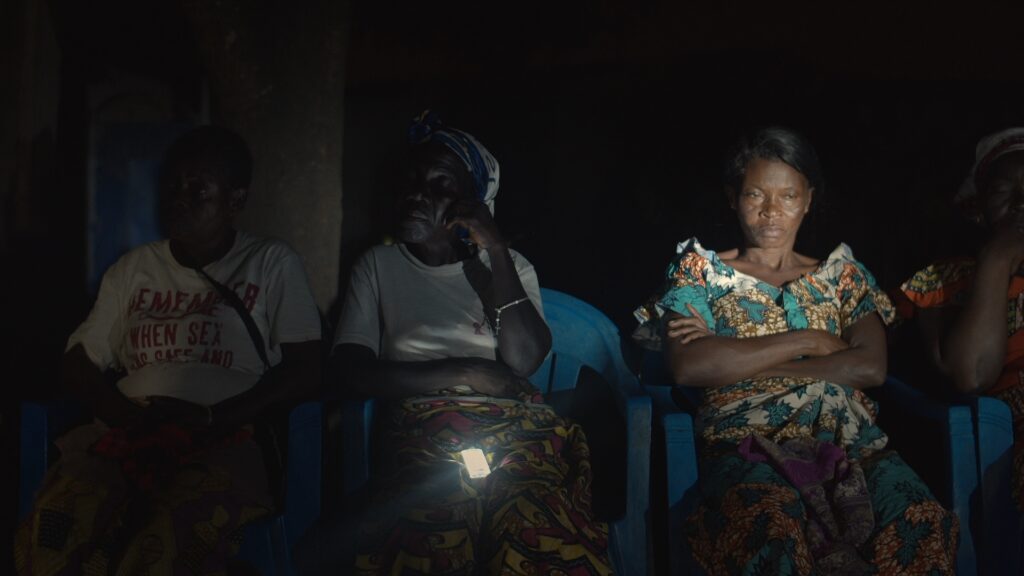
That was the central question of the film: how do you film the night without light? After all, we’re talking about territories where all geographical landmarks are erased. In a sense, everything in the city becomes connected: there are no more borders, differences, or hierarchies. We used LED torches and lamps, but the challenge quickly went beyond lighting and became a question of storytelling as in these places the notion of time takes a back seat.The best way to tell the story was then to connect with the people I was filming. It was difficult, but this challenge was at the heart of the film: how, without elaborate staging, do you manage to convey that unique feeling of being plunged into the dark?
Your unique work with sound contributes to the immersive effect of the film. Can you tell us more about that?
Compared to lighting, working on the sound was relatively easy. Since everything was happening at night, I had to somehow stage the sound, and for that, I chose to push the sound to the extreme to capture the city’s soundscape. Among all the things we did in post production, additional sounds, and different mixes, I had fun using the many sounds we recorded in the streets of Kinshasa during the day. I simply added them to images filmed at night, and without realising it, it changes the ambiance of what we see because these are lively sounds. Day overlaps with night to maximise the experience.
You emphasise the lively aspect of the film, and it’s true that, even though the subject is serious, there is a galvanising collective feel.
There are many major social concerns in Congo, but there is undeniably a force that propels us forward, and that force is very impressive. Take for example the woman living in a flooded house. Her son tries to convince her to leave, explaining that she could drown, but she simply responds that she has nowhere else to go. This way of approaching human nature is incredible.
“This way of approaching human nature is incredible”
This scene has a particular origin. Initially, my desire was to film members of a weightlifting club to hear them talk about their dreams and hopes, to listen to them talk about life as it should be. By spending time with them, they became my friends and brothers. One of them, named Davido, suggested one day that I come and film his mother whose house was flooded. I initially declined, but one night he came to pick me up at four in the morning, and we took a canoe to reach the house. That’s when I fully realised the magnitude of the situation. That’s where the film changed, in fact. That’s where the weight of the narrative evolves. Of course, I had often heard before that certain neighbourhoods had been flooded, but arriving on the scene, the team and I realised that we hadn’t anticipated the impact it would have on us and that we had no idea how to stage what we were seeing. How do you film people living underwater? It took time for us to digest this. We were offered to spend the night there, but I barely slept.
How did you select the different individuals we see in the film?
Before the start of filming, I had more or less written ideas, but it was especially during the filming that the first groups emerged, like Davido’s group. What’s interesting about this approach is that once you find people who easily integrate, you can communicate ideas to them, but they each take hold of the film in their own way. It’s up to you to follow them or not, depending on what you believe is good for the film. I had setup ideas, but in the end, what they give you is inevitably superior to your expectations; it’s up to you to find the balance.
For example, if I initially wanted to film the pastor during the night of December 31st, it’s because of the tradition that most churches hold vigils on that night, and at midnight, prayer gives way to what is called trance. It’s a moment of upheaval that I wanted to film, but that night, the pastor told me that the program had changed, and they were all going to a sacred mountain a bit away from the centre to pray for the future of the country. I followed them, and it was very enriching. The night offers a framework; everyone puts into it what they want, and I wanted to evoke this idea through my camera.

In the groups you film, women often play an important role.
Communities sometimes need individuals to raise awareness, encourage self- reliance, and it’s often women who take on that responsibility. While they may not be the ones connecting the electrical cables, and indeed, we see them waiting for engineers to do so, they are the ones initiating a collective fundraising effort to purchase the cable. What I wanted to film is how a collective can address fundamental issues in this way.
Can Tongo Saa be considered a portrait of Kinshasa?
Yes, I truly wanted to treat the city as a character in its own right, not just as a place for identification or exploration. What we perceive of the city could just as well mirror what is inside the people we encounter there.
During the final credits we hear different people introducing themselves and offering their wishes. Where did this idea come from?
The film takes place more or less during the New Year period. At that time, there is a very festive atmosphere in Kinshasa that continues throughout January. During this period, many radio shows invite listeners to record messages with their wishes for their loved ones. I find this tradition fantastic, so I took advantage of the filming to randomly record people. Concluding the film with this nod to a genuine tradition allowed it to broaden its horizons.