A conversations between Yun-hua Chen and director Yi-Shan LO
This movie isn’t just about Chun; it’s very much about your personal journey and reflections. Can you elaborate on why you decided to create this film in the first place? What motivated you to embark on this project, and why did you choose this particular format?
The mountain accident of Chun and Yueh occurred around March and April of 2017, and it profoundly impacted me. There was a period of over a month during which they were out of contact, and during that time, I mentally prepared myself for the possibility of receiving unfavourable news. When the news finally arrived, it was complex. This experience sparked within me a strong urge to document something, although initially, I wasn’t quite sure what that something would be. I had no prior experience in filmmaking and was essentially starting from scratch. It was right after Yueh returned to Taiwan. He felt relatively optimistic and proactive at that time, and he told me Chun’s last wish: for the survivor to share their stories. During a visit to Yueh in the hospital, we decided to honour Chun’s memory by publishing a book featuring his writings and creating a film.
The initial impetus for making this film was to fulfil Chun’s final wish, and Yueh joined me in this endeavour; it became a collaborative project between Yueh and me. Yet, as depicted in the film, Yueh’s attitude changed over time. Following this shift, I found myself re- evaluating my reasons for undertaking this project. While it may have appeared on the surface that I was making the film for Chun and Yueh, after much introspection, I realised that I was confronting my own trauma related to their mountain accident. I came to understand that my trauma stemmed from my absence during their journey, unable to participate and follow their actions first-hand. I felt a profound longing to have been there with them when it happened, wishing to experience what they experienced. This desire, while seeming naive in hindsight, was a very real sentiment at the time. This unfulfilled desire, coupled with the trauma of being excluded from their experiences and, ultimately, from Chun’s life entirely, as well as the tragic outcome of the event, compelled me to recognise the necessity of making this film. Film, with its exploration of time and space, offered me a means to immerse myself in Chun’s life and to compensate for my absence during their journey in a cinematic manner, even if I couldn’t do so in reality. It became my final opportunity to connect with Chun’s life. While the film initially centred on the event itself, it ultimately became a journey of self-discovery and transformation, focusing on the internal struggles I needed to confront.

This film delves into your divergent ways of coping with grief. Did you discuss this divergence with each other openly?
“since I wasn't in the cave, I felt compelled to visit the site in order to confront, process, and come to terms with the trauma”
The divergence in attitudes, as I later came to understand, stemmed from a crucial distinction: Yueh was present in the cave with Chun and experienced everything first-hand. His trauma was rooted in his presence during the tragedy. In contrast, I was absent, and thus felt the need to physically immerse myself in the site of the incident. Our differing perspectives arose from the disparity between our presence or absence. Yueh, understandably, was hesitant to dwell on or openly express his grief. For him, returning to Nepal or continuing with the film would be indulgence in the past. In my case, since I wasn’t in the cave, I felt compelled to visit the site in order to confront, process, and come to terms with the trauma. My process of grappling with trauma has also impacted people like Yueh who are dealing with it in their own way, potentially leading to irreversible changes in relationships. Capturing these transformations in the film is a genuine and vital aspect of the narrative.
What does the timeline of this project look like? When did it transition into your own film project?
Following the mountain accident in 2017, there was a period of intense filming. The segment featuring Yueh was filmed until the end of 2018, spanning approximately one and a half years. In 2019 and 2020, I took a break to focus on completing my undergraduate degree. Originally, I had planned to travel to Nepal in 2020, but due to the pandemic, I had to put the project on hold. In 2021, I resumed filming in a more calm and self-aware manner. In 2022, I travelled to Nepal to capture the final part of the footage, and I edited the film from mid-2022 until September 2023.
Did anyone go to Nepal with you and film with another camera?
I went there twice, and most of the footage we see in the film was captured during the second visit. During the first trip, I filmed the majority of the footage myself. During the second trip, most of the first-person point-of-view shots were done by me, but some static shots were filmed by a cameraperson from Taiwan. We also met some independent filmmakers in Nepal who assisted us in negotiating on-site production logistics. This included a trekking guide who was our interpreter and facilitator. Their support was instrumental in navigating the unfamiliar terrain of Nepal and ensuring a smooth filmmaking process. It is worth noting that the footage of me going into the cave was self- filmed.
Your film weaves together different periods of time in your life, encompassing your trip to Nepal, the mountain accident, the period right after Yueh returned home, and the high school days shared by Chun and you. What is your approach to cinematic time in this film?
During filming and editing, we dedicated considerable thought to the concept of time, recognising its multifaceted nature within the narrative. Initially, we entertained complex ideas, including the possibility of structuring the film in reverse or incorporating reconstructed scenes. Upon closer examination, however, we concluded that such an approach might fragment the narrative and dilute its impact. Ultimately, we opted for a chronological storytelling method. We chose to begin with the moment when I received news of Chun’s passing and Yueh’s survival, marking the onset of the trauma. From there, the narrative unfolds chronologically, tracing the evolution of the relationship between Yueh and myself before delving into my solo journey to Nepal.
Within this chronological framework, we aimed to present the coexistence of past and present through the very act of revisiting past high school memories alongside current experiences, rather than merely reconstructing the past directly. Furthermore, we juxtapose the archives of the mountain disaster, news reports, and contemporary events, gradually unveiling the complete narrative of the incident in a fragmented yet coherent manner. While rooted in the present, I am surrounded by the memories of the past; past and present collectively paint a fuller picture of the narrative.
The segments featuring the students in high school uniforms were intentionally designed. Opting not to include footage shot in our high school, we chose to incorporate off-screen voice-overs to evoke Chun’s presence at that time, with a rather experimental approach to evoke the past rather than a straightforward representation.

How much footage did you have for the film?
We amassed a significant amount of footage, totalling around 30 terabytes, which equates to over 500 hours of material. During the selection process, we invested considerable time in determining the narrative perspective, ultimately aligning it with my personal journey from receiving news of the mountain accident to reconciling with my trauma. We curated the footage to reflect this narrative arc, discarding scenes that didn’t contribute to this trajectory. For instance, we omitted extensive footage depicting Yueh’s life at university and work, as the film primarily focuses on my reflections on trauma and my relationship with Chun. Scenes featuring Yueh were included only insofar as they pertained to Chun or the event itself, eschewing portraits of our daily lives.
Can you discuss the use of the pronoun “he” to refer to Chun, and your considerations around gender identity in this context?
Chun identified his sexual identity as transgender. Our high school environment, being rather conservative, posed numerous challenges for Chun, and I witnessed his struggles and moments of unhappiness first-hand. Our bond was forged during this period of adversity. The paramount consideration for me was whether we could speak on Chun’s behalf. While we have recordings and writings from Chun, these materials never explicitly stated his gender identity as transgender. As the director, I refrained from imposing a “coming-out” narrative on Chun’s behalf. What I contemplated was how Chun would wish to be addressed and regarded in terms of gender. This led us to use the pronoun “he. ” We used the pronoun “he” to maintain consistency with Chun’s self-identification as male. Towards the beginning of the film, Chun is introduced through a black-and-white, somewhat blurred photo where gender is not clearly discernible. It’s not until later in the film, when I discuss our experiences at a girls’ high school, that the stress and anguish associated with having a female biological body and Chun’s sexual identity are explored. Towards the film’s conclusion, I read aloud Chun’s final writing, in which he expresses feeling like a “pure boy” and characterises his relationship with Yueh as “both lovers and brothers. ” This encapsulates Chun’s personal understanding of gender and his recognition of the unique nature of the relationship with Yueh.
Yueh and you have discussed Chun’s spirit extensively. What do you think Chun’s spirit is?
During their harrowing 40-day ordeal in the cave, Chun turned to writing as a means of coping with the physical and psychological suffering he faced. Towards the end of his writings, Chun reflected on the inception, recalling the initial moments of purity and beauty when everything was so wonderful that it was hard to believe. He revisited memories of our high school encounters and his first love letter to Yueh, conveying a longing for life and a quest for reconciliation with his own existence. This is very powerful. It is Chun’s spirit that supported Yueh.
What do you think about the role of the mountains in the film?
“While I gazed upon the mountains through photographs initially, towards the film's end, I confronted the mountains in Nepal directly, with my own eyes.”
The imagery of mountains plays a significant role in the film, serving as a powerful backdrop and symbol. Although the significance of mountains is not explicitly discussed, approximately 90% of the film’s settings are situated in mountainous regions. We deliberately chose diverse mountain settings, ranging from the lush forests of Taiwan to the high-altitude peaks of Nepal, to illustrate the evolving landscape and transformations along my journey. Even scenes set indoors incorporate nature sounds, reinforcing the connection to the mountains. Ultimately, the encounters between Chun, Yueh, and myself are intimately intertwined with the mountainous terrain.
In After the Snowmelt we aimed to capture the multifaceted nature of mountains, acknowledging both their allure and their harsh realities.Before the mountain incident, Chun expressed his desire to pass away amidst the mountains, and at that time I couldn’t help but express my envy for such a sentiment — an admittedly romanticized and naive view of mountains’ allure. Yet, we also sought to portray the inherent cruelty of mountains, highlighting the coexistence of their appeal and their unforgiving nature. In the footage shot in Nepal, we juxtaposed photos of mountainous landscapes with actual mountain vistas; it is like humanity ‘s perpetual quest to connect with these majestic formations. Despite our emotional projections onto mountains, they remain indifferent entities composed of raw materials, impervious to our desires.
While I gazed upon the mountains through photographs initially, towards the film’s end, I confronted the mountains in Nepal directly, with my own eyes. For me, this is like a kind of reconciliation with my trauma. When Chun was trapped in the cave, he found solace in the book “A Sand County Almanac, ” which contemplates the eternal nature of mountains juxtaposed with the transient existence of human life. In Chun’s final writings, he didn’t harbour resentment towards the mountains for his suffering. Instead, he found a form of catharsis by comprehending and accepting inherent cruelty of mountainous terrain. That’s also why I felt compelled to confront the mountains and revisit the cave as part of my own journey through trauma. It was a process of admitting my own naivety in confronting the mountains and recognizing its cruelty—a crucial step towards healing and reconciliation. Similarly, Yueh found solace in the mountains following his rescue, returning to their embrace during moments of frustration. Despite our divergent paths, the mountains remained a common refuge for each of us.
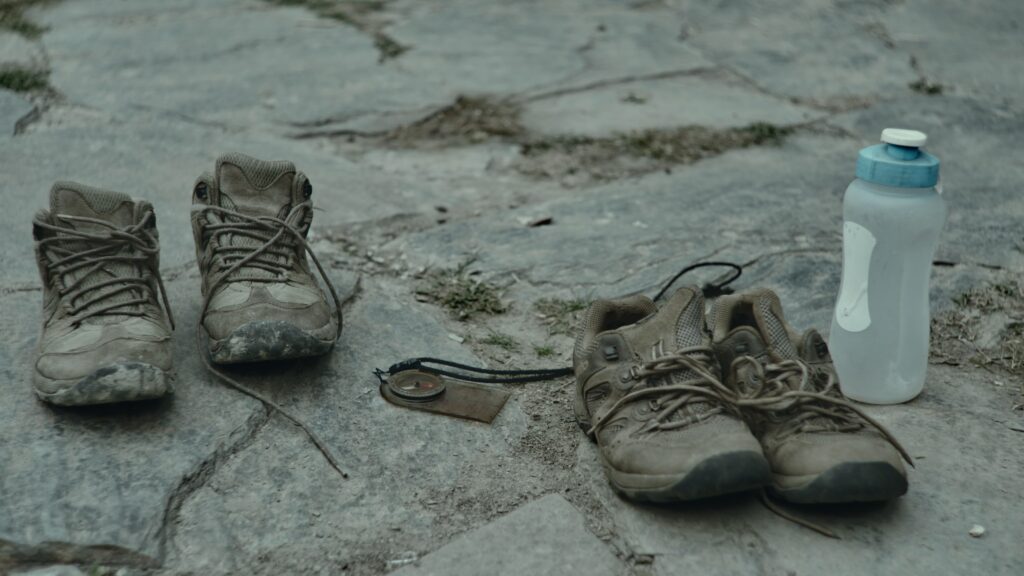
Has Yueh seen the film?
Yueh has not watched the film and he does not want to do so. We provided him with project plans and text files containing subtitles, enabling him to understand the materials used and his portrayal within the film. Discussions with Yueh have been conducted in text form. While Yueh himself has not viewed the film, individuals in his immediate circle, including his current partner, have watched it, allowing him to gain insight into the film’s content.
As Chun uses his language to eternalize his existence, did you feel that filmmaking works in a similar way for you?
Indeed, it does. Following the mountain accident, we published a book compiling Chun’s writings, titled “Everything I Told You About that Mountain, ” approximately two years later. The primary motivation behind this publication was to ensure that Chun’s words were preserved and shared. While trapped in the cave, Chun utilized writing as a means of expression and connection amidst extreme loneliness. The book perpetuates his longing to communicate and forge connections with others, and filmmaking works in a similar way too. This film originated from a genuine desire to document my experiences, preserving memories and facilitating dialogue with others. In essence, the essence of art lies in its capacity to foster communication and empathy, transcending individual experiences to connect with others.